
Gold was the highest-returning major asset class of 2025, advancing approximately 64% on the year. Its appreciation was supported by multiple reinforcing factors: elevated geopolitical uncertainty driving safe-haven demand, U.S. dollar weakness, sustained central bank accumulation, and strong inflows into gold-backed ETFs. Together, these forces created both structural and flow-driven support for prices.
Momentum extended into early 2026, with gold surpassing $5,000 per ounce and rising nearly 18% in January alone. While the magnitude of this advance is notable, it also reinforces the importance of revisiting assumptions about gold’s risk and return characteristics.
Revisiting Strategic Assumptions
New Frontier’s 2025 investment framework supported a modest 2–5% strategic allocation to gold. That positioning was grounded in two core assumptions:
- Gold provides reliable diversification and downside risk mitigation.
- Gold does not carry a persistent long-term return premium relative to other risk assets.
Recent performance invites scrutiny of both premises.
If gold can appreciate this rapidly, it can also retrace meaningfully. Elevated returns introduce the potential for greater forward volatility, particularly if driven by flows rather than fundamentals. At the same time, sustained multi-year strength raises legitimate questions about whether structural demand shifts—such as expanded ETF access, increased central bank diversification away from reserve currencies, and broader retail participation—could alter long-term return expectations.
At present, our forward return forecasts remain conservative and our risk assumptions cautious. We continue to treat gold primarily as a strategic diversifier rather than a growth asset. Its portfolio role remains centered on resilience, inflation hedging potential, and diversification benefits, particularly during periods of systemic stress.
Gold Versus Other “Store of Value” Assets
Gold’s consistency in 2025 contrasted with other perceived stores of value.
- Silver delivered an exceptional year and outperformed gold in absolute return terms. However, silver historically exhibits higher volatility and greater correlation to global industrial and equity cycles. Its performance profile is more cyclical and less purely defensive.
- Bitcoin declined approximately 6% in 2025. Digital assets remain highly sensitive to investor flows and ETF-related liquidity dynamics. In periods of stress, concentrated redemptions have amplified price movements. Since the launch of spot ETFs, price action has been increasingly influenced by fund inflows and outflows, reinforcing flow-driven volatility.
This divergence reinforces our strategic view: gold functions as a portfolio stabilizer with empirically demonstrated diversification properties, whereas other precious and digital assets have exhibited more episodic and flow-dependent behavior (note gold’s lower standard deviation and equity correlation below).
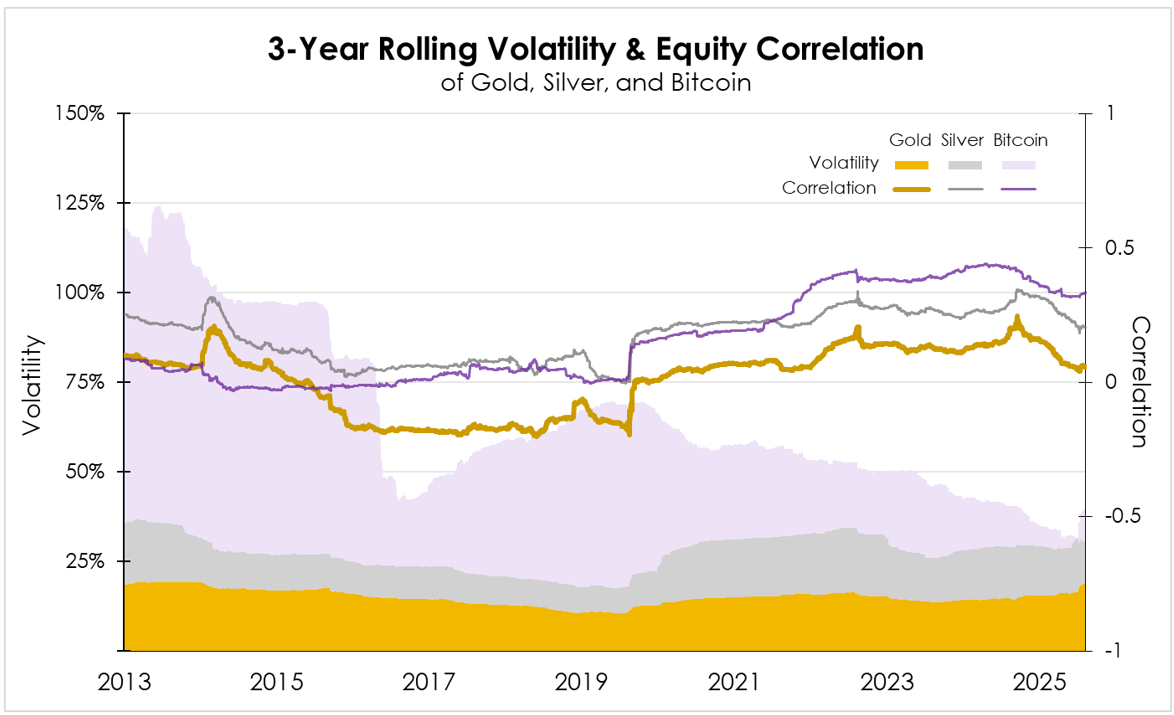 Source: Bloomberg
Details: Annualized volatility and correlation against the S&P 500 using daily returns, and over a 3-year window.
A Note of Caution
It is difficult to explain gold’s spectacular recent appreciation by investment theory alone. The unusual global economic shifts would have caused strong demand-driven price appreciation for gold, but that alone does not explain the price change. At the same time, positive real rates for safe haven assets such as cash and bonds should marginally reduce demand for gold.
Additionally, making an asset easily accessible via ETFs changes its behavior. While gold ETFs have been available for some time, they are increasingly popular among a new pool of buyers, which means the asset is now far more susceptible to the sentiments of retail investors. The conclusion is significant speculative interest accompanied the underlying economic drivers. This speculation will likely persist as a significant source of risk.
Portfolio Construction Implications
Despite extraordinary recent performance, we do not advocate treating gold as a high-growth asset. Instead:
- Maintain disciplined strategic allocations.
- Avoid extrapolating short-term performance.
- Reassess forward risk assumptions in light of increased volatility potential.
- Monitor structural demand shifts (central bank activity, ETF flows, currency regimes).
Though volatility will likely be elevated in 2026, gold’s long-term value proposition remains grounded in diversification and risk mitigation - not speculative return enhancement.
Link to Author Bio
Robert Michaud